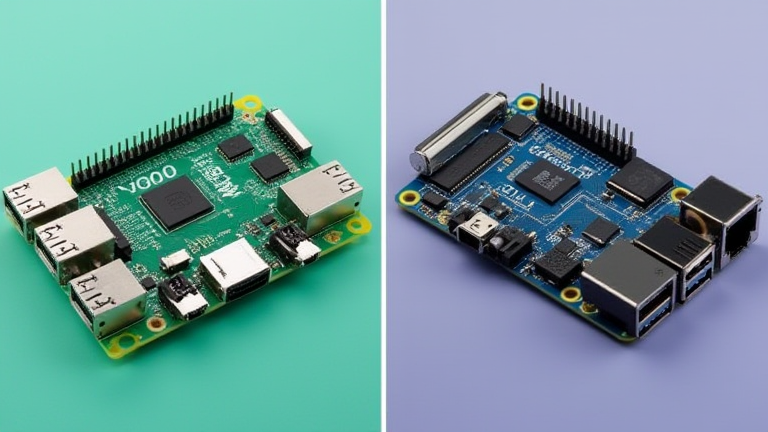
Raspberry Pi 5 vs. Odroid: Which Single-Board Computer Should You Build Your Home Lab On?
TL;DR: Choose the Raspberry Pi 5 if you prioritize massive community support, extensive peripheral compatibility, and ease of integration for general-purpose home lab tasks. Select the Odroid H4 or N2+ if you require higher raw CPU performance, better thermal efficiency, or specific hardware acceleration for compute-intensive applications like AI inference or high-resolution video transcoding.
The New Powerhouse: Raspberry Pi 5
The release of the Raspberry Pi 5 marked a significant leap forward for the industry, finally addressing the performance ceiling that had constrained the Pi 4 for years. Equipped with a quad-core Arm Cortex-A76 processor running at 2.4 GHz, the Pi 5 offers a substantial speed boost over its predecessor. Crucially for home lab builders, the new Compute Module 5 (CM5) allows for server-grade reliability in compact form factors. The board features dual 4K HDMI outputs, improved power management via the dedicated power management IC, and enhanced GPIO capabilities. This makes it an ideal candidate for running lightweight Docker containers, network monitoring tools like Zabbix, or as a low-power gateway for smart home protocols. The extensive ecosystem of case designs, cooling solutions, and software packages ensures that troubleshooting issues is rarely a challenge, as nearly every problem you encounter will have a documented solution in the vast Raspberry Pi forums.
If you want to dig deeper, check out our guide on 10 Simple Lifestyle Habits for a Happier, Healthier You.
The Performance Challenger: Odroid
On the other side of the aisle, Hardkernel’s Odroid lineup, particularly the H4 and the newer N2+, challenges the Pi’s dominance in raw throughput. The Odroid H4, powered by an ARM Cortex-A72 quad-core CPU and an ARM Mali-G51 GPU, generally outperforms the Pi 5 in sustained multi-threaded workloads. Its superior thermal design allows for higher sustained clock speeds without aggressive fan cooling, which is a critical factor in a 24/7 home lab environment. Furthermore, Odroid boards often include more generous amounts of RAM out of the box, making them better suited for running multiple virtual machines or high-memory-demand applications. The industry impact of Odroid is significant in niche fields such as edge computing and AI, where the specific instruction sets and hardware accelerators can provide a tangible advantage over the more generic Pi architecture.
Industry Impact and Future Outlook
The competition between these two giants drives innovation across the single-board computer market. As cloud costs rise and data privacy concerns grow, the demand for local, on-premise computing solutions increases. Both manufacturers are responding by improving hardware accelerators for encryption and video processing. For the average home lab enthusiast, the choice often comes down to workflow. If your lab relies heavily on standard Linux distributions and a wide array of plug-and-play accessories, the Pi 5 is the safer bet. However, if your focus is on squeezing maximum computational power from a small footprint, the Odroid remains a formidable contender. Ultimately, both platforms are viable, but the Pi 5’s ecosystem maturity gives it a slight edge for most users, while the Odroid serves those who need specific performance metrics.
FAQ
Q: Which board has better long-term software support?
A: The Raspberry Pi 5 currently has broader and more consistent long-term software support due to its larger user base and official foundation backing.
Q: Is the Odroid more energy-efficient than the Pi 5?
A: Generally, yes, the Odroid H4 and N2+ tend to be more energy-efficient under sustained load due to more mature ARM architectures and better thermal management.
Q: Can I easily switch between the two platforms?
A: Yes, most home lab software is containerized or runs on standard Linux distributions, making it relatively easy to migrate configurations between Pi and Odroid boards.
Leave a Reply