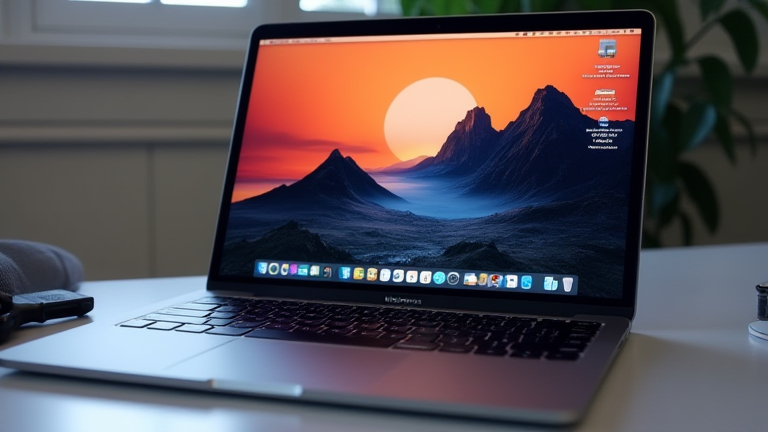
How the M4 MacBook Pro Changes Pro Workflows
TL;DR: The M4 MacBook Pro revolutionizes professional workflows by delivering unprecedented single-core performance and unified memory bandwidth, allowing complex rendering and AI tasks to run locally without cloud dependency. It effectively eliminates thermal throttling during sustained heavy loads, ensuring consistent output for video editors, 3D artists, and developers working on large-scale projects.
The release of the latest MacBook Pro series marks a significant inflection point in mobile workstation capabilities. For years, professionals were forced to choose between the portability of a laptop and the raw power of a desktop tower. The M4 chip series shatters this dichotomy, offering desktop-class performance in a chassis thin enough to fit into a standard backpack. This shift is not merely incremental; it represents a fundamental change in how creative and technical professionals approach their daily tasks. By leveraging advanced process nodes and a sophisticated architecture, Apple has created a machine that handles real-time 8K video editing, complex 3D simulations, and large language model inference with a level of efficiency that was previously reserved for server racks.
Specs That Matter
Under the hood, the M4 and M4 Pro chips feature a significantly enhanced CPU core structure. The performance cores are now capable of handling multi-threaded workloads with greater efficiency, reducing the time spent waiting for compile jobs or render queues. Equally important is the unified memory architecture. With up to 48GB of unified memory on the Pro models and higher configurations on the Max variants, the system can handle massive datasets that would traditionally require external storage or cloud offloading. This high-bandwidth memory access is critical for AI-driven applications, where the speed at which data moves between the GPU and CPU dictates the responsiveness of generative tools. The dedicated neural engine has also seen a substantial throughput increase, enabling on-device processing of sophisticated machine learning models without sacrificing battery life or thermal headroom.
Industry Impact and Workflow Shifts
The industry impact is profound. Film production companies are beginning to adopt these laptops for on-set color grading and dailies review, as the display technology paired with the M4’s color processing capabilities ensures accurate representation without needing external reference monitors. In software development, the ability to run full-stack local environments, including heavy Docker containers and local LLMs, accelerates iteration cycles. Developers no longer need to wait for cloud CI/CD pipelines for initial testing; they can validate changes locally in seconds. For 3D artists, the improved Metal framework support allows for real-time ray tracing previews that were once impossible on battery power. This leads to a workflow where the “wait time” is minimized, allowing creative flow to remain uninterrupted. The reduction in external power dependencies also means that remote work setups become more viable, as the machine can sustain high performance for hours without a constant power source, freeing professionals from tethered desk environments.
FAQ
Q: Is the M4 MacBook Pro better than a desktop workstation?
A: For most creative and development tasks, yes. The M4 Pro and Max chips offer performance comparable to high-end desktops while providing superior efficiency and portability, making them ideal for hybrid workflows.
If you want to dig deeper, check out our guide on Hybrid AI Office Design: The Future of Remote Work.
Q: Can I run large AI models locally on this device?
A: Yes, the increased unified memory and neural engine throughput allow for running large language models and image generation tools locally, providing privacy and speed advantages over cloud-based solutions.
Q: How does the M4 improve battery life under heavy load?
A: The advanced 3-nanometer process and efficient architecture mean that the M4 delivers higher performance per watt, allowing users to sustain intensive workloads for significantly longer periods on a single charge compared to previous generations.
Leave a Reply