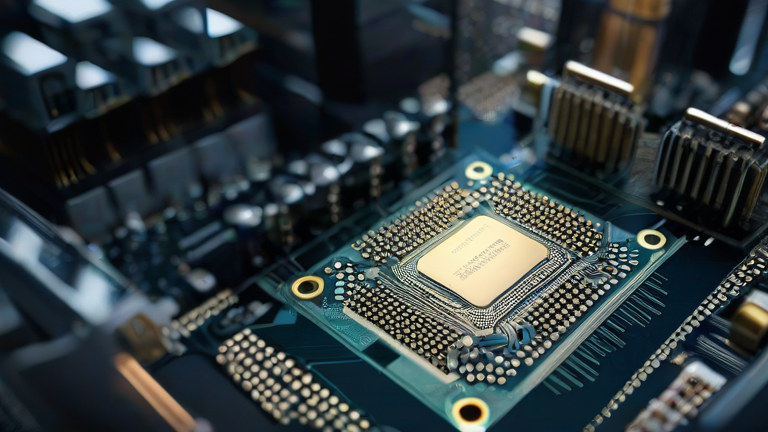
TL;DR: Quantum computing has crossed from lab curiosity to engineering reality, with 2024–2025 milestones in error correction, qubit scaling, and cloud access bringing commercial viability within roughly five to ten years. The remaining hurdles are error rates, cryogenic infrastructure, and software maturity—not fundamental physics.
Error Correction Reaches the Break-Even Point
The defining milestone of the past two years is the demonstration of quantum error correction (QEC) at scale. In late 2024, Google’s Willow chip showed that adding physical qubits to a surface-code lattice reduced logical error rates exponentially—the long-sought “below-threshold” regime. IBM followed with its Heron-based QEC experiments and a roadmap targeting 200 logical qubits by 2029. Quantinuum’s trapped-ion systems, meanwhile, reported logical qubit fidelities exceeding 99.9% in 2025. These results matter because error correction is the single gate between noisy prototypes and useful machines: a commercially relevant algorithm may require thousands of logical qubits, each built from hundreds of physical ones.
If you want to dig deeper, check out our guide on Minimalist Wardrobe: 12 Timeless Pieces That Actually Work.
Hardware Scaling: Superconducting, Trapped-Ion, and Neutral Atoms
Superconducting circuits remain the most mature platform. IBM’s Condor packed 1,121 qubits into a single chip in 2023, and its newer architectures prioritize connectivity and gate fidelity over raw count. Google’s Willow offers 105 qubits with dramatically improved coherence times. Trapped-ion players—Quantinuum’s Helios and IonQ’s Forte—trade speed for fidelity and all-to-all connectivity, with IonQ reporting algorithmic qubits (#AQ) in the low thirties. Neutral-atom approaches from QuEra and Pasqal are scaling fastest of all, with arrays of over 1,000 atoms and reconfigurable geometries ideal for analog simulation. The industry consensus: no single modality wins yet, and hybrid classical-quantum workflows will dominate early deployments.
Industry Impact: Where Quantum Pays First
Commercial value is arriving in narrow but high-value niches. Pharmaceutical and chemical firms—including Roche, Boehringer Ingelheim, and BASF—are using quantum simulation on cloud platforms to model molecular interactions that classical computers approximate poorly. Finance is testing portfolio optimization and Monte Carlo acceleration with banks like JPMorgan Chase and Goldman Sachs running pilot programs. Logistics and materials discovery round out the early adopters. Cloud access via AWS Braket, Azure Quantum, and IBM Quantum has lowered the barrier: startups can now rent time on 100+ qubit systems without owning dilution refrigerators. Analysts at McKinsey estimate the quantum market could reach $100 billion by 2035, though near-term revenue remains modest and concentrated in hardware and services.
What Still Stands in the Way
Three obstacles define the path to viability. First, error rates must fall another order of magnitude for fault-tolerant operation at scale. Second, cryogenic and control infrastructure remains expensive and bulky—modular, room-temperature control electronics are an active research front. Third, the software stack lags hardware: compilers, error-mitigation libraries, and quantum-aware algorithms are immature, and the talent pool is thin. Standards bodies like IEEE and ISO are beginning to address interoperability, which should accelerate enterprise adoption.
FAQ
Q: When will quantum computers be commercially viable?
A: Narrow commercial applications exist today via cloud access, but broad fault-tolerant viability is generally projected for the early-to-mid 2030s, contingent on error-correction scaling.
Q: Will quantum computers replace classical computers?
A: No. Quantum machines will act as accelerators for specific problem classes—simulation, optimization, and cryptography—while classical systems handle everything else in hybrid workflows.
Q: What should enterprises do now?
A: Build quantum literacy, run cloud-based pilots in simulation and optimization, and track QEC milestones; early experimentation lowers adoption risk when hardware matures.
Leave a Reply